Barvincsenko (LEWIT)
A method for releasing joint blocks that combines elements of bone-setting, osteopathy and chiropractic. Works well for spine, neck and shoulder complaints, as well as cartilage wear and joint inflammation.
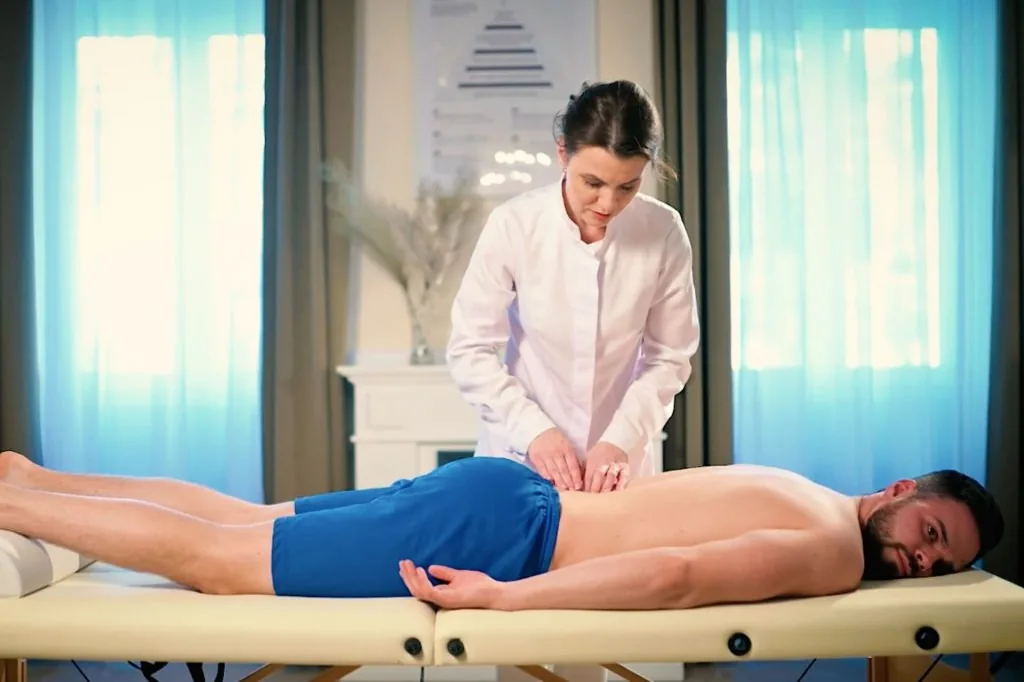
Using specific hands-on techniques, our therapist restores correct joint movement and releases tight muscles. The treatment is gentle, yet its effect is often felt after the very first session.
Manual therapy is both a treatment and a diagnostic tool: while working with their hands, our therapist can feel exactly which joint or muscle group lies behind your complaint. Used regularly, it improves how joint surfaces fit together, boosts circulation and speeds up recovery of the affected tissue.
The treatment also releases tight connective tissue (fascia), which in many cases brings instant relief. We also aim to restore proper muscle balance and a healthy spinal posture.
While physiotherapy calls for active effort on your part, manual therapy is a passive method — the therapist's hands do the correcting while your body settles back into balance.

Gentle handling — no sudden, forceful movements.
Many of our patients feel a change after the very first session.
Performed only by experienced therapists and doctors.
Works without medication, so there are no side effects.
Requires no active effort from you — the therapist does the work.
Gives us a precise picture of what's causing your complaint while we treat it.
If you're struggling with joint or muscle-related pain, manual therapy is likely to bring fast relief.
Our therapists draw on several internationally recognised methods to find the techniques that suit you best.
A method for releasing joint blocks that combines elements of bone-setting, osteopathy and chiropractic. Works well for spine, neck and shoulder complaints, as well as cartilage wear and joint inflammation.
An internationally recognised approach built on a thorough musculoskeletal exam that treats the source of the pain rather than just the symptom — for joint, nerve and connective-tissue complaints alike.
New Zealand physiotherapist Brian Mulligan's technique pairs passive joint mobilisation with active movement. Restoring the correct joint position can relieve pain almost instantly.
Based on the Anatomy Trains system, this treatment mobilises and stimulates connective tissue to correct musculoskeletal imbalances.
The Fascial Distortion Model restores twisted connective tissue. Especially effective for acute pain, restricted movement and deep muscle pain.
We take a detailed history, then physically assess your posture, the range of motion of your vertebrae and any asymmetries.
We determine which manual therapy techniques suit you and set out the recommended treatment schedule.
If you're happy with the plan, we get to work from the very first session. Improvement is often felt within a few treatments.
No, manual therapy is a deliberately gentle procedure with no sudden, forceful movements. Our therapists always adjust the handling to your pain tolerance.
For milder complaints, 2-5 sessions are often enough; for more persistent problems we recommend a longer programme, which we'll outline after your first assessment.
In physiotherapy you actively work your own muscles. In manual therapy the therapist performs the movement and correction by hand, while you take part passively.
No. We only work with trained, experienced manual therapists using proven, safe techniques.
In case of acute inflammation, fever or a recent injury, a medical check-up is needed first. If you're unsure, just give us a call.
A helping hand that reconnects your body with the way you move. Our team is waiting for you at our Buda clinics, ready to work on the solution together.
Válaszd ki a kerületed, és nézd meg, melyik budai rendelőnk esik hozzád a legközelebb.
Subscribe and be the first to receive useful articles, exercises and offers about musculoskeletal health.